
How a representative New York farm project can progress from site screening through design, construction, commissioning, and performance verification
NYSERDA’s Sun and Soil Program can help move an innovative farm-energy concept from early analysis into design, construction, and performance evaluation. But an agrivoltaic project is not simply a solar array placed on agricultural land. The energy system must be designed around continuing farm production, and the farm operation must remain practical after the electrical equipment is installed.
The following example illustrates how a typical project might progress from initial assessment through implementation. It is not an actual NYSERDA award, a prescribed system design, or a guarantee of eligibility. Every application under Program Opportunity Notice 6206 must be supported by site-specific engineering, agricultural input, utility information, costs, and program requirements.
The Illustrative Project
Consider a diversified specialty-crop farm in Upstate New York. The property includes approximately 150 acres, a packing barn, refrigerated storage, irrigation pumps, a small processing area, and several acres near the main electrical service that are suitable for continued crop production.
The farm’s annual electricity use is approximately 280,000 kWh. Its summer demand is driven by irrigation, cooling, packing, and refrigeration, while cold-storage equipment remains a critical load during utility outages. The owner is considering a 150-kWDC agrivoltaic solar array paired with a 100-kW/200-kWh battery-energy-storage system.
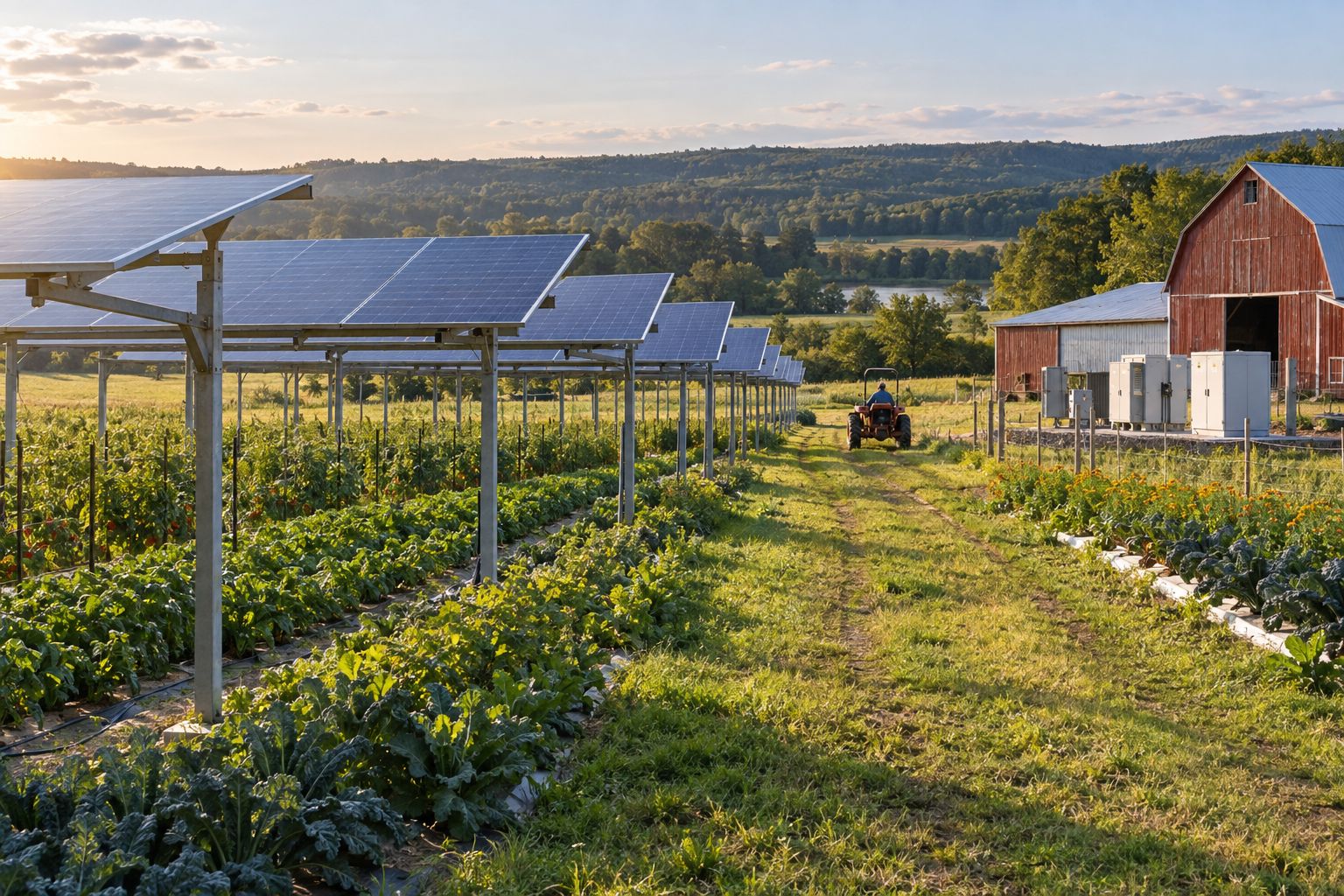
The preliminary concept is to continue growing shade-tolerant specialty crops within and between elevated solar rows. The project would offset farm electricity purchases, test crop performance under partial shade, and provide limited backup support to selected refrigeration and control loads. The system size and configuration are illustrative; the final design would depend on interval utility data, the crop plan, available area, interconnection capacity, structural loading, and project economics.
Stage 1: Confirm That the Project Solves a Real Farm Problem
The first assessment should begin with the farm’s objectives—not with a solar equipment proposal. A useful kickoff discussion establishes what the owner is trying to accomplish:
- Reduce purchased electricity and exposure to future utility-rate increases
- Protect harvested products during short grid outages
- Maintain or improve the productive use of the selected acreage
- Avoid interference with planting, cultivation, harvesting, and material handling
- Develop a project that can be monitored and replicated at other New York farms
- Use available funding without committing the owner to an unsuitable developer or commercial structure
At this stage, the project team should also identify constraints that could make the concept impractical. These may include poor solar exposure, insufficient contiguous land, shallow bedrock, wetlands, flood risk, prime-soil concerns, restrictive easements, inadequate utility capacity, or a farm plan that is incompatible with the required racking geometry.
A promising concept is one in which the agricultural purpose is specific and measurable. “Growing crops near solar panels” is not enough. The proposal should identify which crops will be tested, why partial shading may be beneficial or manageable, how machinery will enter and turn, and how crop yield and quality will be compared with a control area.
Stage 2: Establish the Energy Baseline and Critical Loads
Monthly utility bills are useful, but they rarely provide enough information to design the system. The engineer should obtain at least 12 months of electricity usage and demand data and, when available, interval data showing how farm loads change through the day and season.
The assessment should separate ordinary energy use from critical loads. For the illustrative farm, the critical-load panel might serve one refrigerated storage room, communications, selected controls, emergency lighting, and a limited water-pumping load. Large resistance heaters, all irrigation pumps, and the entire packing facility may be excluded from backup operation because supporting them would require a much larger battery and inverter.
This distinction prevents a common misunderstanding: adding a battery does not automatically allow the entire farm to operate during an outage. The design must define:
- Which loads will remain energized
- Their starting and running power requirements
- The desired backup duration
- Whether solar can recharge the battery during an extended outage
- How noncritical loads will be disconnected
- How the system will transition safely between grid-connected and islanded operation
For this example, the 200-kWh battery may provide several hours of support to a carefully controlled critical-load group. Actual duration would depend on usable battery capacity, load cycling, ambient conditions, reserve settings, and whether solar production is available.
Stage 3: Match the Solar Layout to Agricultural Operations
Conventional solar design tends to optimize energy yield, installed cost, and access for electrical maintenance. Agrivoltaic design adds another operating system: the farm itself.
The concept layout should be developed with the farmer and an agricultural specialist. Key decisions include panel height, row spacing, foundation location, tracking versus fixed-tilt racking, crop-row orientation, headlands, fencing, drainage, snow management, and routes for tractors and emergency vehicles.
For the specialty-crop example, an elevated fixed-tilt or tracking system could provide working clearance beneath portions of the array, while wider row spacing could preserve sunlight and equipment access. However, increasing height and spacing can increase steel, foundation, wiring, and installation costs. Tracker movement can also affect available clearance at different times of day.
The “ideal” site is therefore not simply a flat, sunny field. A strong project site typically has:
- Good solar exposure with limited shading
- Soil and drainage conditions compatible with both farming and foundations
- Practical proximity to the farm’s electrical service and critical loads
- Adequate space for setbacks, equipment turning, construction staging, and fire access
- A defined agricultural plan that can continue throughout the project
- A feasible utility-interconnection path
- Site control for the full project and monitoring period
- An owner and farm operator willing to participate in data collection and adaptive management
Stage 4: Resolve the Highest-Risk Technical Questions Early
Several project risks should be investigated before the application relies on a fixed cost or schedule.
Utility interconnection. The utility may require studies, protection changes, metering modifications, export limits, or distribution-system upgrades. A project intended primarily to serve farm loads may still export energy during low-load periods. Interconnection cost and timing can materially affect feasibility.
Geotechnical and civil conditions. Test pits, soil information, and preliminary foundation analysis help determine whether driven piles are practical. Rock, weak soils, frost, drainage patterns, and erosion risk can force a different foundation or site layout.
Structural configuration. Higher agrivoltaic racking must resist wind, snow, and unbalanced loading while maintaining farm clearances. The structural concept should be sufficiently developed to support a realistic budget—not inferred from the cost of conventional low-height solar.
Electrical service and controls. The team must confirm service voltage, switchgear capacity, available fault current, transformer limitations, metering arrangement, and a safe point of interconnection. Battery controls must coordinate solar production, utility requirements, farm demand, backup reserves, and emergency shutdown.
Agricultural performance. Partial shade changes soil temperature, moisture, evapotranspiration, and crop conditions. Panel drip edges can concentrate water and cause erosion or uneven growing conditions. The farm plan should include crop selection, irrigation changes, soil protection, equipment movements, and a control plot for comparison.
Permitting and code compliance. Local land-use approvals, building and electrical permits, fire-department access, battery siting, environmental review, and agricultural-district considerations should be mapped before construction is promised.
Stage 5: Build a Credible Application and Implementation Plan
A strong Sun and Soil application connects the project need, technical concept, agricultural value, team qualifications, budget, schedule, risks, and measurement plan. The application should show what is known, what still requires investigation, and how unresolved issues will be managed.
For an implementation proposal, the project team may include the farm owner or operator, independent energy engineer, agricultural specialist, solar and storage designer, civil and structural engineers, installer or developer, utility representative, controls provider, and data-analysis partner. Responsibilities should be assigned before submission so important work is not assumed to belong to someone else.
The project schedule should allow decision gates. For example, final procurement should not occur until the utility path, structural concept, site plan, permits, and major equipment requirements are sufficiently defined. A realistic sequence may include:
- Baseline assessment and concept validation
- Survey, geotechnical work, and agricultural design criteria
- Interconnection application and utility review
- Design development, permitting, and procurement
- Site preparation and foundation installation
- Racking, modules, electrical work, battery, and controls
- Startup, commissioning, and operator training
- Agricultural production and multi-season performance monitoring
The budget should carry appropriate allowances for engineering, utility requirements, specialized racking, foundations, civil work, controls integration, commissioning, monitoring, and contingency. Underpricing the project to make an application appear attractive can create a funding gap later.
Stage 6: Protect the Farm During Construction
Construction planning should be tied to the agricultural calendar. Heavy equipment can compact soil, damage subsurface drainage, interrupt irrigation, block farm roads, or contaminate growing areas if access and restoration requirements are not defined.
Contract documents should identify limits of disturbance, approved haul routes, soil-stockpile practices, wet-weather restrictions, erosion controls, protection of drainage and utilities, crop-loss responsibilities, and restoration standards. The owner’s representative should document existing conditions and monitor work that will later be concealed, including foundations, underground conduits, grounding, and drainage features.
Long-lead equipment and seasonal constraints must also be considered. Missing a planting window or entering a field during saturated conditions can affect the farm for more than one season, even if the solar work remains technically on schedule.
Stage 7: Commission the Complete Energy and Agricultural System
Completion is more than verifying that the array produces power. Commissioning should confirm that the installed system matches the approved design and performs safely under normal, abnormal, and outage conditions.
Typical verification includes equipment inspections, torque and labeling records, insulation and grounding tests, inverter startup, protective settings, communications, meter accuracy, battery charge and discharge, emergency shutdown, critical-load transfer, alarms, remote monitoring, and owner training. Functional testing should verify the intended control sequence—for example, whether the battery preserves an outage reserve while also managing demand or solar export.
Agricultural readiness should be reviewed at the same time. The team should verify equipment clearances, gates, fencing, irrigation routing, drainage, soil restoration, and safe access around electrical equipment. A project cannot be considered successful if the solar system operates but the farm can no longer work efficiently around it.
Stage 8: Measure Results and Adjust Operations
The monitoring plan should be designed before construction so that the required sensors, meters, control plots, and data platforms are included in the project budget.
Energy metrics may include solar production, farm consumption, exported energy, peak demand, battery throughput, backup events, system availability, and utility-cost savings. Agricultural metrics may include yield, crop quality, soil moisture, temperature, irrigation use, labor, equipment access, and operating cost. Weather data and a comparable control area help explain whether observed changes are attributable to the agrivoltaic configuration rather than seasonal variation.
The first operating season will likely reveal adjustments. Irrigation zones may need rebalancing, vegetation management may require modification, battery dispatch settings may need refinement, or equipment routes may need clearer controls. Performance verification turns those findings into documented lessons rather than unresolved complaints.
What Makes This Project Replicable
NYSERDA’s program is intended to generate information that benefits more than one property. The illustrative project becomes more valuable when its design assumptions, construction challenges, agricultural results, energy performance, and operating changes are documented in a form that other farms can use.
Replicability does not mean every farm should install the same 150-kW solar array or 200-kWh battery. It means the project produces a transferable method: how to screen a site, define critical loads, establish agricultural clearances, evaluate interconnection risk, protect soil during construction, commission controls, and measure both farm and energy performance.
MEE’s Role from Assessment Through Verification
Mayflower Energy Engineering can serve as the farm owner’s independent technical representative throughout the project. With more than 25 years of energy-engineering experience and more than 10 years working with NYSERDA programs, MEE can help define the project before a developer’s solution becomes the default.
MEE’s support may include energy and critical-load analysis, feasibility studies, conceptual sizing, lifecycle-cost evaluation, proposal development, design criteria, developer and contractor review, owner’s representation, construction oversight, commissioning, and performance verification.
That integrated role is especially valuable for agrivoltaics because the project must coordinate farm operations, energy systems, specialized design disciplines, utility requirements, funding documentation, and long-term data collection. Learn more about MEE’s energy engineering services, engineering design and implementation services, and project experience.
Farmers and project partners considering a Sun and Soil proposal should begin with a structured screening of the site, farm operation, energy use, and project team. Contact Mayflower Energy Engineering to discuss whether a proposed project is technically credible and ready for the next funding round.